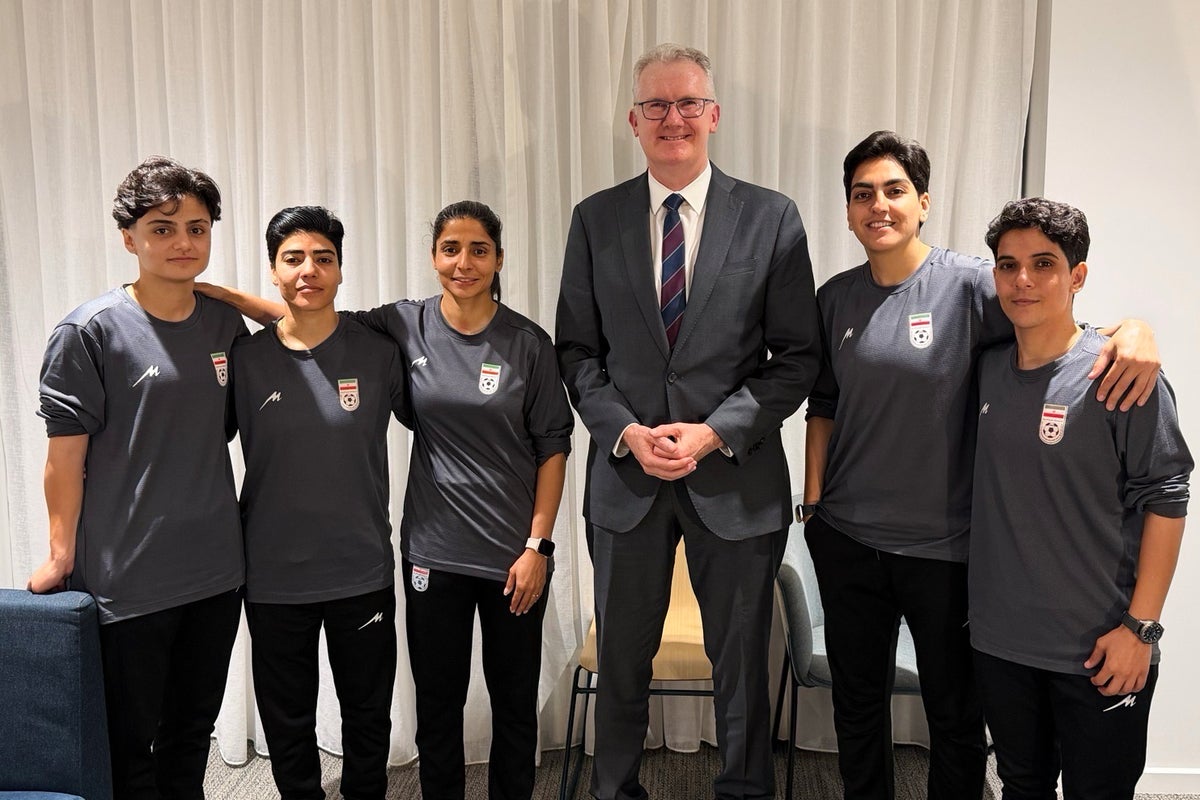
The granting of asylum to five Iranian women footballers by the Australian government is not merely a humanitarian gesture; it is a calculated intersection of international law, soft power projection, and the systematic failure of sports governance to protect high-value human capital. This event highlights a structural shift in how national borders respond to the "dual-threat" profile of female athletes from restrictive regimes: individuals who possess both high public visibility and a documented history of state-enforced professional suppression.
The Tri-Factor Risk Profile of the Iranian Female Athlete
The eligibility of these five athletes for protection under the 1951 Refugee Convention hinges on a specific risk profile that differentiates them from standard asylum seekers. In the context of the Iranian state, the female footballer operates within a "Triple-Jeopardy" framework:
- Systemic Gender-Based Persecution: The mandatory enforcement of religious dress codes (hijab) during international competition creates a non-negotiable friction point between FIFA regulations and state law.
- Political Activism by Association: Participation in global sport inherently exposes athletes to liberal democratic norms. When an athlete returns to a restrictive home environment, their refusal to adhere to domestic social constraints is viewed as a direct challenge to the state's sovereignty.
- High-Visibility Erasure: High-performing female athletes represent a branding contradiction for the Iranian state. They are useful for nationalistic displays of competence but dangerous as symbols of female autonomy.
The Australian Department of Home Affairs evaluates these cases through the lens of "well-founded fear," where the "fear" is not a subjective emotion but a measurable probability of state-sponsored reprisal upon return. By granting these visas, Australia acknowledges that the professional identity of these women is inseparable from their political risk.
The Mechanics of the Sport-State Conflict
The conflict that necessitated this asylum grant originates in the friction between the Internal Legal Reality (ILR) of Iran and the External Regulatory Requirements (ERR) of global football bodies like FIFA and the AFC.
When an athlete is forced to choose between ERR compliance—necessary for professional advancement—and ILR compliance—necessary for physical safety—they enter a state of "Functional Statelessness." They are physically within their country but legally and professionally incompatible with its survival requirements. Australia’s intervention acts as a market correction, extracting talent from an environment where its "utility value" is being suppressed by non-market forces (state ideology).
The Strategic Logic of Australian Asylum Policy
Australia’s decision to facilitate the safe passage of these athletes serves three distinct strategic objectives that move beyond simple altruism.
Soft Power Optimization
Hosting the 2023 FIFA Women’s World Cup established Australia as a central hub for the growth of the women’s game. By providing a permanent home to Iranian dissidents, the Australian government reinforces its position as the "moral high ground" of the sporting world. This creates a competitive advantage in future bidding processes for international events, as the nation demonstrates a commitment to the safety of the participants that surpasses the minimum requirements of a host city contract.
Talent Acquisition and Integration
From a sports-performance perspective, the "cost of acquisition" for these players is essentially zero for the Australian domestic leagues (A-League Women). The state absorbs the initial resettlement costs, while the sporting infrastructure gains five mid-to-high-tier professional assets. This is an efficient transfer of human capital. Unlike standard economic migrants, these athletes arrive with a pre-validated skill set and a built-in public profile, reducing the "time-to-productivity" within the Australian economy.
The Precedent Bottleneck
While this move is a success for the five individuals, it creates a "Bottleneck of Precedent." There is no scalable mechanism for the thousands of other female athletes in similar positions across different sports and regions. This specific asylum grant was likely expedited due to the high visibility of football. It reveals a tiered hierarchy of protection:
- Tier 1: Athletes with international caps and media footprints (High probability of asylum).
- Tier 2: Domestic-level professionals with localized risk (Moderate probability).
- Tier 3: Amateur or youth prospects (Low probability, high barrier to entry).
Institutional Fragility in Global Sports Governance
The necessity of state-level asylum for footballers highlights a profound failure in the "Neutrality Doctrine" of organizations like FIFA. For decades, the mantra that "sport and politics should not mix" has allowed governing bodies to ignore the domestic safety of the athletes they profit from.
The Iranian case demonstrates that when a state uses sport as a tool for social control, the "Neutrality Doctrine" effectively sides with the oppressor. There is currently no "Athlete Safety Fund" or "International Sporting Passport" that allows players to bypass state control. Consequently, the burden of protection falls entirely on individual nations like Australia, creating a fragmented and inconsistent global safety net.
The Cost Function of Professional Displacement
We must quantify the impact of displacement on the athletes' professional trajectories. The "Athletic Decay Rate" is a critical variable here. A professional footballer’s peak earning window is approximately 8–10 years. Every month spent in legal limbo, transit, or processing centers is a month of unrecoverable physical capital.
The Australian pathway minimizes this decay by integrating the five players into the Melbourne-based "A-League" environment. However, the psychological toll of permanent exile remains a "hidden liability" that can affect on-field performance. The success of this asylum initiative will be measured not by the granting of the visa, but by the "Retainment Rate" of these players in professional football over the next 36 months.
Moving Toward a Sovereign Athlete Model
The Australian intervention signals the beginning of the "Sovereign Athlete" era. In this model, high-performing individuals in restrictive regimes will increasingly look to leverage their global market value to secure political leverage or exit strategies.
National sporting federations in democratic countries should prepare for an influx of "Athletic Refugees." This requires the development of a structured Talent-Resettlement Pipeline (TRP). Instead of reactive, case-by-case asylum grants, a proactive TRP would involve:
- Risk Assessment Audits: Identifying "at-risk" athletes during international tournaments hosted on domestic soil.
- Private-Public Partnerships: Coordination between government immigration departments and professional leagues to ensure immediate employment and housing.
- Legal Shielding: Providing athletes with the resources to contest nationality-based bans or state-enforced retirement.
The primary limitation of this strategy is the potential for "Retaliatory Blacklisting." If Iran or similar regimes perceive that international tournaments are being used as "exit ramps" for their talent, they may simply cease participation or intensify domestic surveillance. This would paradoxically lead to the total isolation of the very athletes these programs seek to help.
The strategic play for Australia—and other nations following this blueprint—is to formalize the link between "International Sports Hosting" and "Human Rights Compliance." By making the safety of athletes a non-negotiable term in hosting agreements, the global community can shift the burden from reactive asylum to proactive protection. If a state cannot guarantee that its athletes can return home without fear of reprisal for their participation, that state should face immediate suspension from the global sporting apparatus. This forces a choice upon the regime: domestic control or international relevance. For the five Iranian women now in Melbourne, that choice was made for them; for the thousands left behind, the global governance model must evolve from a reactive provider of sanctuary to a proactive enforcer of athlete sovereignty.