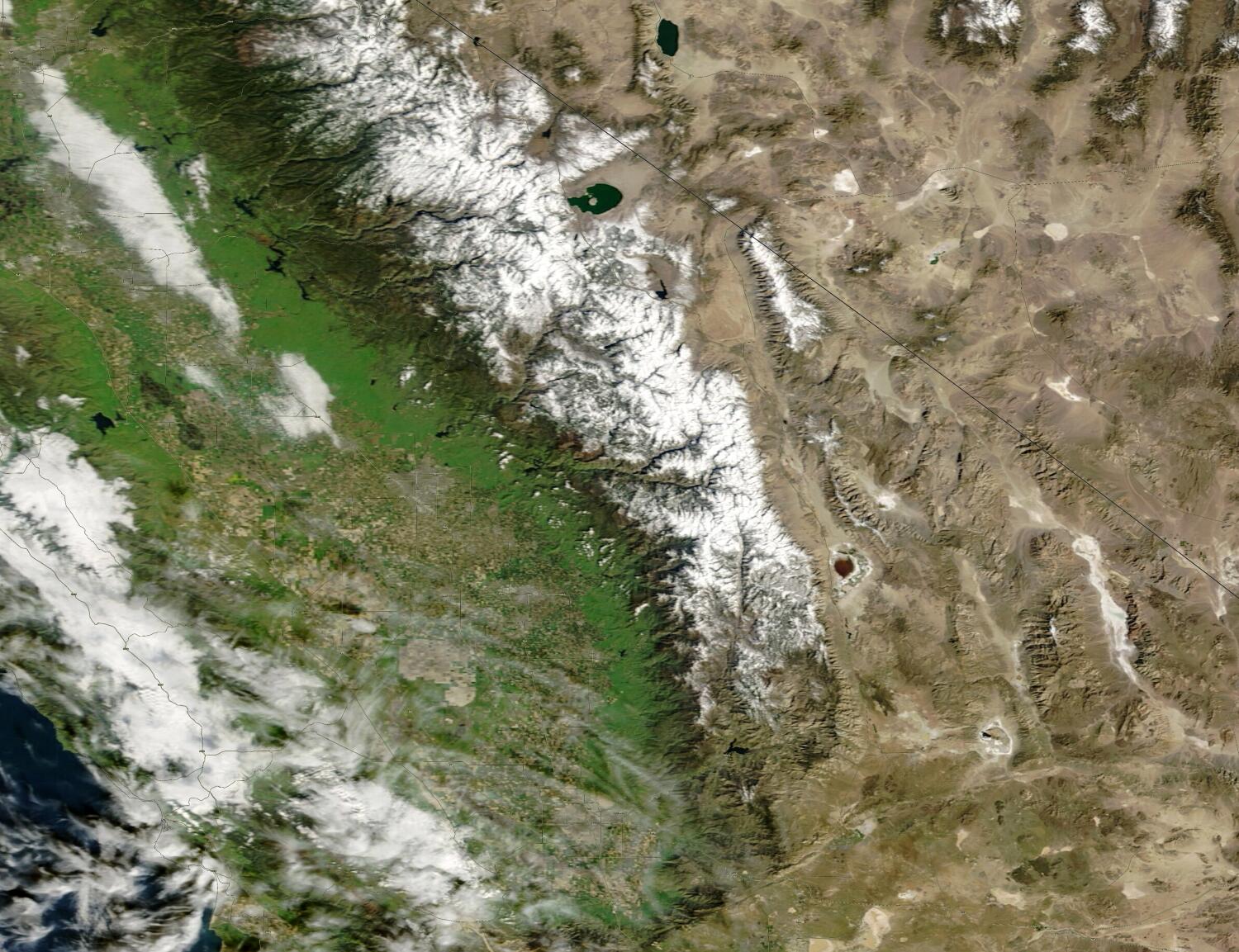
The air at 8,000 feet doesn’t just smell like pine; it smells like a promise. For generations of Californians, that promise was written in white. You could look up from the sweltering valley floor in June and see the jagged peaks of the Sierra Nevada still draped in heavy, crystalline blankets. It was our frozen bank account. It was the insurance policy that kept the taps running and the almond trees blooming through the long, scorched summers.
Then, in a single heartbeat of geologic time, the vault door swung open.
If you look at the satellite imagery from this past spring, the change isn't a gradual fade. It’s a wipeout. One week, the mountains are a blinding, ivory spine. The next, they are a bruised purple and slate gray, stripped bare. We are witnessing a "snowmelt shock" so violent it has left hydrologists staring at their sensors in disbelief.
Imagine a farmer named Elias. He’s hypothetical, but his anxiety is written into the DNA of every Central Valley grower. Elias doesn't check the stock market when he wakes up. He looks at the "snow water equivalent" charts. He knows that a thick snowpack is a slow-release vitamin for his soil. When that snow melts over four months, the infrastructure—the dams, the canals, the local reservoirs—can catch it. It’s a gentle handoff from the mountains to the dirt.
But when the snowpack vanishes in a matter of days? That’s not a handoff. That’s a heist.
The Physics of a Vanishing Act
The science behind this isn't just about "warmth." It’s about a feedback loop that feels almost spiteful. When the snow begins to melt prematurely, it exposes the dark rock and soil beneath. While white snow reflects nearly 80% of the sun’s energy back into space, dark earth drinks it. The ground gets hotter. The air above it follows suit. Suddenly, the remaining snow isn't just melting from the top down; it’s being cooked from the bottom up.
This year, the atmospheric conditions aligned to create a "perfect thaw." We had a massive winter—the kind of old-school, house-burying snowfall that made us feel like the drought was finally a ghost of the past. We felt rich. But the heat arrived with a sudden, predatory intensity.
Consider the sheer volume of energy required to turn billions of tons of ice into rushing water. Normally, this process is a slow burn. This time, it was a flash fire. In certain high-altitude basins, the snowpack levels dropped by several inches of water content per day. For context, the energy involved in that kind of phase change across the entire range is equivalent to a staggering number of industrial heaters running at full blast, 24 hours a day.
The result is a hydrologic whiplash. The rivers don't just rise; they scream.
The Invisible Stakes of a Ghost River
Most people in Los Angeles or San Francisco see the snow through a camera lens or a windshield on their way to a ski resort. They don't see the "dead pool" levels at the reservoirs or the frantic calculations being made by water managers in Sacramento.
When the snow melts too fast, the math stops working.
Our dams have a maximum capacity. They are designed to catch a steady stream, not a tidal wave. When the Sierras shed their coat all at once, the reservoirs fill to the brink. Managers are forced to make a gut-wrenching choice: let the water flow out to the Pacific Ocean to prevent the dam from overtopping, or pray the levees downstream can hold the surge.
Every gallon that rushes into the ocean in May is a gallon that won't be there in September. We are watching our summer survival go down the drain because the mountains couldn't hold onto it for just a few weeks longer.
The emotional toll on these mountain communities is visceral. I spoke with a man who has lived near Mammoth Lakes for forty years. He described the sound of the creeks this spring as "angry." It wasn't the cheerful babble of a mountain stream. It was the roar of a freight train. He watched the meadow behind his house go from three feet of snow to a muddy bog in less than a week.
"It felt like the seasons skipped a beat," he told me. "Like we went from February to July and just forgot that Spring was supposed to happen."
Why the "Average" Year is a Lie
We often hear meteorologists talk about "percentage of normal." This year, we were well above 100%. On paper, we won. But "normal" is a dangerous fiction in a changing climate.
The total volume of water is only half the story. The timing is the protagonist.
$Q = \Delta S / \Delta t$
In this simple relationship, $Q$ is the discharge, $S$ is the snow storage, and $t$ is time. If you shrink the time ($t$), the discharge ($Q$) becomes a monster. You can have all the water in the world, but if it arrives all at once, it’s a disaster rather than a resource.
We are moving into an era where the "frozen reservoir" of the Sierra Nevada is no longer a reliable storage facility. It’s becoming a leaky bucket. This changes everything from the price of a head of lettuce to the fire risk in the foothills. When the snow leaves early, the forests dry out early. The "fire season" used to be a few months in late autumn. Now, the clock starts ticking the moment the last patch of white disappears from the peaks.
The Human Cost of a Dry Summer
Think back to Elias and his almond trees. He sees the satellite photos and he doesn't see "interesting weather data." He sees a ticking clock. He knows that by August, the groundwater pumps will have to work harder. He knows the local well-water levels will drop as the valley tries to compensate for the missing mountain runoff.
There is a specific kind of grief in watching a landscape transform so violently. It’s called solastalgia—the distress caused by environmental change while you are still at home. It’s the feeling of looking at a familiar horizon and realizing it no longer follows the rules you grew up with.
The Sierra Nevada is the heart of California’s water system, and that heart is beating too fast.
We aren't just losing snow. We are losing the rhythm of the West. The slow, predictable cycle of accumulation and release has been replaced by a chaotic staccato of "feast or famine." One year we are drowning; the next we are parched. And sometimes, as we've seen this year, we manage to be both in the span of a single month.
The satellite photos don't lie, but they don't tell the whole truth either. They show the "what," but they can't capture the "why" or the "so what." They can't capture the look on a park ranger's face when he realizes the high-country trails are bone-dry two months early. They can't capture the vibration in the ground as a billion tons of water seeks the lowest point.
The brown peaks staring back at us from space are a warning. They are a mirror. They reflect a world where the constants are vanishing, and the things we took for granted—the slow melt, the cool breeze, the summer stream—are becoming luxuries we can no longer afford to waste.
The mountain is still there, of course. But the soul of it, that white mantle that gave the range its name—Sierra Nevada, the Snowy Range—is becoming a seasonal visitor rather than a permanent resident.
Next year, the snow will return. We will celebrate the first dusting. We will track the storms with bated breath. But we will do so with a new, uneasy knowledge: the mountain is no longer a vault. It’s a sieve. And we are the ones standing below, holding out our cupped hands, hoping for a drop that stays long enough to quench the thirst of a valley that never stops asking for more.
The snow is gone. The water is elsewhere. And the long, hot silence of a Sierra summer has arrived far too soon.
Would you like me to look up the latest reservoir capacity levels for the major California basins to see how they're holding up after this melt?