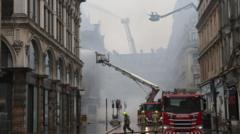
The sight of a passer-by fruitlessly battling a vape shop blaze with a hand-held extinguisher is more than a momentary act of doomed heroism. It is a stark diagnostic of a systemic failure in urban fire safety. When an inferno consumes a commercial unit in minutes, jumping from a single spark to a structural threat, the narrative shouldn't just focus on the bravery of the public. It must focus on why that shop was a tinderbox in the first place.
Modern high streets are changing. As traditional retail retreats, specialized shops—particularly those dealing in high-energy electronics and volatile chemical liquids—have moved in. The speed at which these storefronts transform into chemical fires suggests that our current fire codes and building inspections are lagging decades behind the reality of the products being sold.
The Chemistry of a Modern Shop Fire
Vape shops present a unique trifecta of fire risks that few other retail environments match. You have high-density lithium-ion batteries, large quantities of flammable vegetable glycerin and propylene glycol, and often, an aging building infrastructure not designed for industrial-grade electrical loads.
When a lithium-ion battery enters thermal runaway, it doesn't just burn. It undergoes a self-sustaining chemical reaction that generates its own oxygen. A standard ABC dry chemical extinguisher, the kind a well-meaning passer-by might grab from a neighboring cafe, is often useless against this. In many cases, applying the wrong extinguishing agent or failing to cool the core of the battery can actually mask the fire while the internal temperature continues to climb toward a violent venting of gas.
This isn't just about one shop. It is about the specific thermal profile of modern retail. We are seeing fires that reach temperatures exceeding 1,000 degrees Fahrenheit in a matter of seconds. By the time the fire brigade arrives, the objective has shifted from "save the shop" to "save the block."
Structural Vulnerability and the Chimney Effect
Many of these incidents occur in older buildings where secondary fire-stopping measures have been compromised by decades of renovations. An investigative look at recent urban fires reveals a recurring pattern. A fire starts in a ground-floor retail unit. It hits the ceiling, finds a gap in the fire-rated drywall created for a new air conditioning line or an internet cable, and enters the "void" between floors.
Once the fire is in the walls or the ceiling joists, the building acts like a chimney. The passer-by on the sidewalk sees smoke and tries to help, but the real disaster is already happening out of sight, traveling vertically through the structure. This is how a small electrical fault in a display case becomes a multi-million-dollar insurance claim involving three neighboring properties.
Local councils and fire marshals often lack the resources to conduct the deep-dive inspections required to catch these "hidden" risks. They check for visible extinguishers and clear exits, but they rarely have the mandate to pull back a ceiling tile and check if the fire-stopping foam from 1998 is still intact or if a new tenant has punched a hole through a structural fire wall.
The Regulatory Gap in Specialized Retail
There is a glaring discrepancy between the hazardous nature of the inventory in these shops and the "Light Retail" classification they often carry. If a business stored the equivalent amount of flammable liquid in an industrial warehouse, they would be subject to rigorous containment protocols, specialized sprinkler systems, and mandatory staff training.
On the high street, these same materials are often stacked on wooden shelves in a room with a single domestic smoke alarm.
Inventory Risks
- Lithium Storage: Bulk storage of uncertified or cheap replacement batteries.
- Aerosolization: The risk of pressurized containers exploding when exposed to heat.
- Toxicity: The fumes from burning e-liquids and plastic housing create a toxic smoke that complicates rescue efforts.
Insurance companies are beginning to wake up to this. Premiums for properties housing high-risk electronics or chemical-based retail are spiking. Some underwriters are now requiring specific "Battery Safety Plans" before they will even quote a policy. This market-driven pressure might eventually do what regulation has failed to do: force a standard of safety that matches the actual risk.
Why Intervention Often Fails
The instinct to "do something" is human. However, the reality of modern commercial fires means that untrained intervention is frequently more dangerous than doing nothing. When a passer-by opens a door to a shop that is already heavily involved in smoke, they provide a fresh "gulp" of oxygen. This can lead to a backdraft or a flashover—a terrifying phenomenon where every combustible surface in the room ignites simultaneously.
Training for shop owners is often perfunctory. They are told how to pull the pin on an extinguisher, but they aren't taught the physics of a chemical fire. They aren't taught that their primary job isn't to save the inventory, but to seal the room and evacuate. The "tackle the blaze" mentality is a relic of a time when shops were filled with wool, wood, and paper. In the age of lithium and synthetic polymers, that mentality is a liability.
The Business of Negligence
We have to look at the economic pressures that lead to these fires. In a struggling retail economy, the "pop-up" nature of many specialized shops means that interior fit-outs are done fast and cheap. Non-union electricians or even the business owners themselves might handle the wiring for massive LED displays and charging stations.
The result is a fragile electrical grid pushed to its limit. If you walk into a shop and see "daisy-chained" power strips or extension cords tucked under rugs, you are looking at a fire waiting for a reason to happen. This isn't just "bad luck." It is a calculated risk taken to save on overhead, and when it fails, the public—and the emergency services—pay the price.
Real safety requires a shift in how we view commercial occupancy. We need to move toward a risk-based inspection model where the nature of the inventory dictates the level of fire suppression required. If a shop sells thousands of lithium batteries, it should be legally required to have an automated, specialized suppression system, regardless of its square footage.
The next time you see a headline about a bystander trying to stop a shop fire, don't just admire the bravery. Look at the charred remains of the building and ask why we allowed a chemical warehouse to be disguised as a corner store.
Stop treating every retail space as if it still sells greeting cards and sweaters.