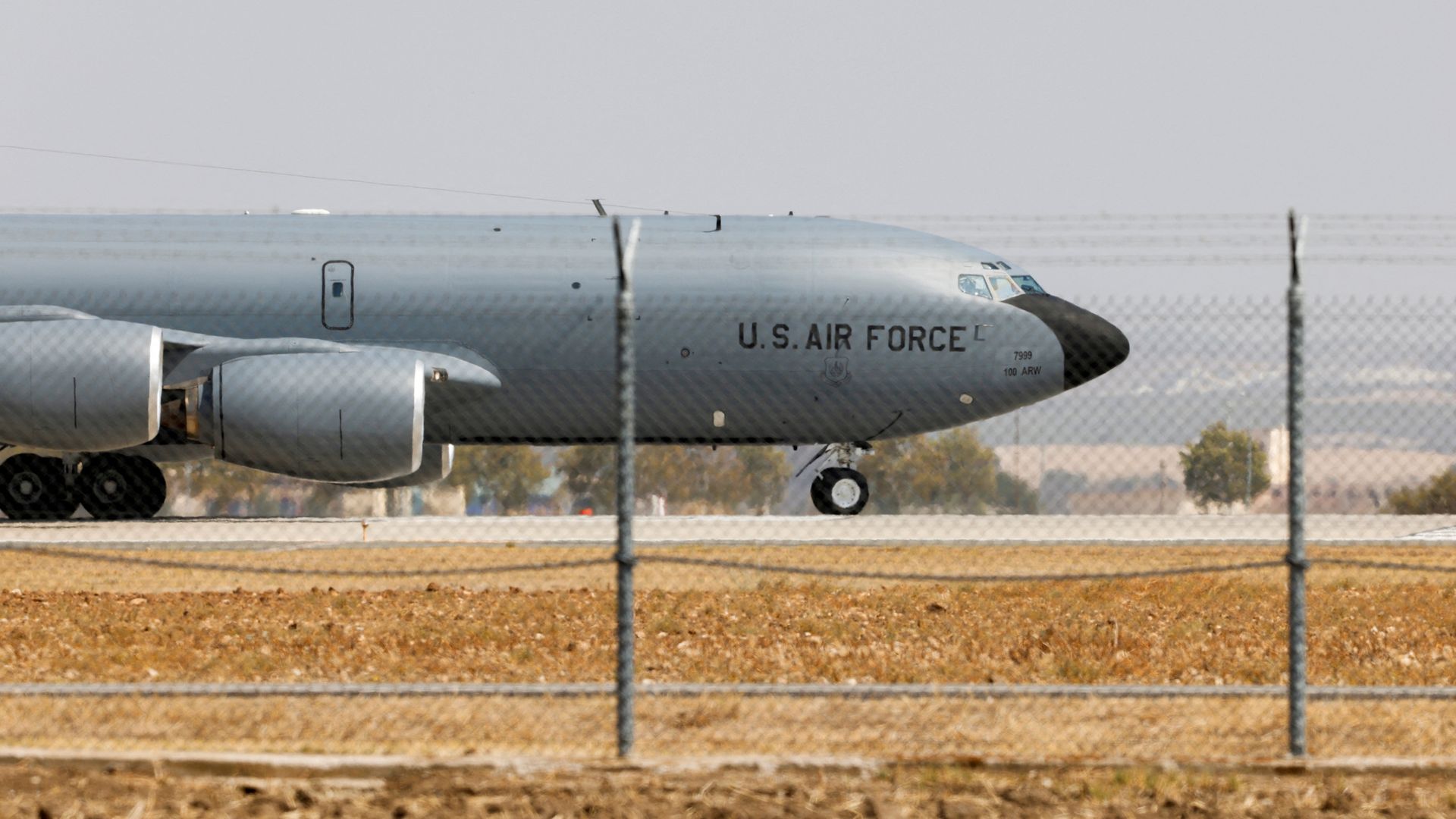
The loss of a U.S. military refueling aircraft and its six-man crew in Iraq represents more than a localized tactical tragedy; it is a critical data point in the systemic degradation of power projection capabilities within contested airspaces. Aerial refueling is the fundamental prerequisite for long-range kinetic operations. When this link in the "kill chain" fails, the operational radius of every strike asset in the theater is instantaneously halved. This analysis deconstructs the incident through the lens of mechanical fatigue, environmental stressors, and the specific vulnerability of heavy-payload tankers in non-permissive zones.
The Strategic Fragility of the Aerial Refueling Bridge
Aerial refueling platforms—primarily the KC-135 Stratotanker, KC-10 Extender, or the newer KC-46 Pegasus—operate as "high-value airborne assets" (HVAA). Their loss is disproportionately impactful compared to tactical fighters because they function as a force multiplier. The failure of such an asset is rarely the result of a single isolated variable. Instead, it typically stems from a convergence of three distinct failure vectors: structural integrity, environmental interference, and kinetic or electronic intervention.
The Triple-Constraint Failure Model
To understand why a heavy aircraft crashes in a combat zone, one must evaluate the intersection of these three pillars:
- Kinetic Vulnerability: Unlike stealth-capable fighters, refueling tankers possess a massive Radar Cross Section (RCS). They are "loud" and "bright" on both active and passive sensor arrays. While usually orbiting in "safe" zones, the fluid nature of modern asymmetric warfare means that MANPADS (Man-Portable Air-Defense Systems) or sophisticated electronic warfare (EW) can turn a standard refueling track into a high-risk corridor without warning.
- Airframe Longevity and Maintenance Cycles: The U.S. tanker fleet is among the oldest in the Department of Defense inventory. The KC-135, for instance, utilizes airframes that often exceed 60 years of service. Metal fatigue, specifically in the wing spars and landing gear assemblies, creates a non-zero probability of catastrophic structural failure during high-stress maneuvers or heavy-load takeoffs.
- The Iraq Environmental Variable: The Iraqi theater presents unique atmospheric challenges. High-density altitude (the combination of heat and elevation) significantly reduces lift and engine performance. Fine particulate ingestion—sand and dust—acts as an abrasive on turbine blades, leading to "compressor stalls" or thermal runaway if the cooling systems are compromised.
Anatomy of a Catastrophic In-Flight Incident
When six personnel are lost, the evidence suggests an event that was either instantaneous or so comprehensive that it overwhelmed redundant flight systems. In heavy multi-engine aircraft, a single engine failure is a manageable emergency. A total loss of the airframe points toward a structural breakup, a mid-air collision, or a massive fuel-system ignition.
Gravity and Fuel Dynamics
A refueling plane is essentially a flying fuel bladder. The physics of "liquid slosh" during aggressive maneuvering or sudden turbulence can shift the center of gravity (CG) beyond the limits of the flight control system's ability to compensate. If an aircraft is carrying 100,000 pounds of JP-8 fuel, a sudden shift in that mass can induce a "departure from controlled flight."
The mechanisms of such a crash involve:
- Rapid Decompression: If the airframe integrity is breached by external fire or internal mechanical failure.
- Asymmetric Thrust: If engines on one wing fail while others remain at high power, inducing a terminal roll that cannot be corrected at low altitudes.
- Avionics Blackout: In environments with heavy electronic warfare saturation, the loss of GPS-guided navigation and fly-by-wire stability can lead to "spatial disorientation" for the crew, particularly during night operations or low-visibility dust storms.
Quantifying the Human and Material Cost
The loss of six crew members is a catastrophic depletion of specialized human capital. Training a boom operator and a heavy-tanker pilot takes years and millions of dollars in investment. Beyond the human cost, the loss of the airframe creates a "capability gap" in the regional Air Tasking Order (ATO).
Operational Impact Calculation
The removal of one tanker from the rotation necessitates a recalculation of all ongoing sorties.
- Sortie Duration: Strike aircraft must now return to base earlier, reducing "time on station" by up to 40%.
- Divert Risk: Without a tanker in the air, any aircraft with a mechanical issue or fuel leak has no "safety net," increasing the likelihood of further airframe losses.
- Logistical Cascades: Other tankers must fly longer hours to cover the gap, accelerating their own maintenance wear and tear, creating a "death spiral" of fleet readiness.
The Myth of the "Safe" Rear-Echelon
A common misconception in military reporting is the categorization of Iraq as a "stabilized" or "low-threat" environment for heavy aircraft. This ignores the reality of modern anti-access/area denial (A2/AD) capabilities. Even non-state actors in the region have access to sophisticated thermal-seeking missiles.
Furthermore, the "hot and high" conditions of the Middle East mean that the margin for error is razor-thin. An engine that performs at 100% efficiency in temperate climates may only produce 85% thrust in the Iraqi summer. This "thrust deficit" means that during an emergency, the pilots have less energy available to trade for altitude or airspeed.
Technical Limitations of Legacy Fleet Integration
The integration of 21st-century sensors onto 20th-century airframes creates a friction point. Legacy tankers often lack the robust "link-16" data sharing or advanced threat-warning systems found in modern fighters. This creates a "situational awareness lag." The crew may not even be aware they are being tracked by a ground-based threat until a launch occurs, or they may lack the automated countermeasures (chaff/flares) necessary to spoof a projectile.
The strategic play for the U.S. and its allies in the region is now a forced modernization or a significant tactical pullback. If the Iraqi theater remains unstable and the legacy fleet remains the primary refueling asset, the frequency of such catastrophic failures is statistically likely to increase. The immediate response must be a theater-wide grounding for airframe inspections, followed by an aggressive pivot toward "distributed refueling" to minimize the single-point-of-failure risk. This requires a transition from a few massive, vulnerable tankers to more numerous, smaller, and potentially autonomous refueling platforms.