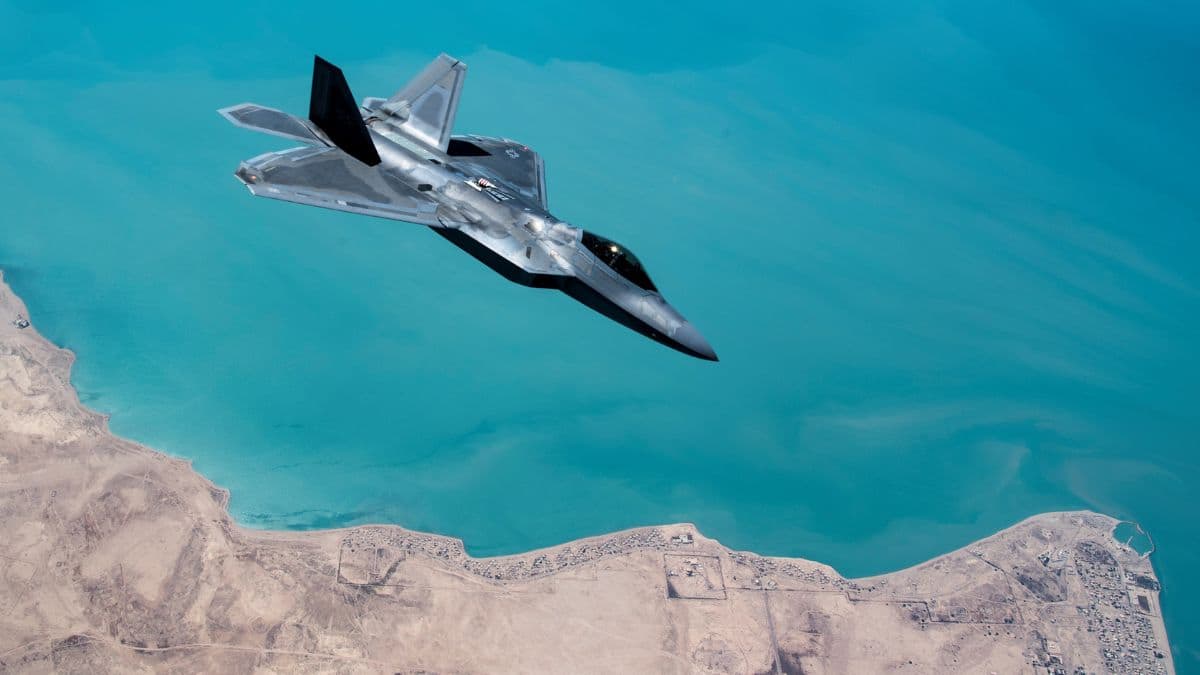
The sound does not arrive at once. It begins as a low-frequency vibration in the marrow of your bones, a rhythmic thrumming that makes the dust on a cracked windshield dance in microscopic patterns. By the time you look up, the sky is empty. Then, a shimmer. A jagged, slate-colored ghost tears through the heat haze of the Levant, gone before the roar of its engines can even register in the human ear.
Six of these ghosts just landed in the sand.
When we talk about the deployment of F-22 Raptors to West Asia, the headlines usually read like an inventory report for a hardware store. We see numbers. We see "stealth capabilities." We see "strategic posturing." But behind the sterile language of a Pentagon press release lies a terrifying, delicate human gamble. These are not just planes. They are the physical manifestation of a whisper—a warning sent across a thousand miles of desert to a room in Tehran where men are deciding the fate of the next decade.
The Raptor is a strange beast. It was designed for a world that no longer exists, a Cold War relic that found its purpose in the absolute mastery of a sky it refuses to share. It does not reflect radar; it absorbs it. It does not just fly; it maneuvers with a physics-defying grace that makes other jets look like lead weights tied to kites. To the pilots sitting in those cockpits, strapped into a multi-billion dollar exoskeleton of carbon and titanium, the world is a digital grid of threats and opportunities. They are the most advanced hunters in the history of our species.
But their arrival isn't about hunting. Not yet.
The Weight of the Invisible
Consider the pilot. Let’s call him "Viper," a hypothetical but representative officer who has spent more hours in a simulator than most people spend in their own cars. He didn't come to West Asia to drop bombs. He came to be a shadow. The primary utility of the F-22 in a diplomatic crisis is its ability to be everywhere and nowhere. It haunts the periphery of enemy radar, a ghost that appears and disappears just enough to remind the opposition that the ceiling above them is no longer private.
This is the "invisible stake" of modern brinkmanship. When the United States moves six of these machines, it isn't just adding firepower to the board. It is changing the psychology of the room. Negotiating with a country like Iran is a game of perceived consequences. Without the Raptors, the conversation is about rhetoric and sanctions—abstractions that feel far away. With the Raptors, the conversation includes the reality of a platform that can dismantle a nation’s air defenses before the first alarm even sounds.
The tension is a living thing. You can feel it in the airbases in Jordan and Qatar, where the ground crews work in 110-degree heat to keep the radar-absorbent skin of these jets pristine. A single scratch, a stray bolt, or a lapse in maintenance can turn a multi-million dollar stealth masterpiece into a very expensive target. The human effort required to maintain "the invisible" is staggering.
A Dialogue of Engines
Why now? The timing isn't accidental. Diplomacy is often described as a delicate dance, but in the Middle East, it’s more like a high-stakes poker game where one player just put a very large, very sharp knife on the table and didn't say a word.
The talks with Iran are reaching a fever pitch. On one side, there is the hope of de-escalation, the dream of a region that isn't constantly bracing for the next explosion. On the other, there is the reality of proxy wars, drone strikes, and the relentless pursuit of nuclear leverage. The F-22s are the punctuation mark at the end of a sentence the U.S. is currently writing.
We are here.
We see you.
Don't.
There is a specific kind of silence that happens in the moments before a major geopolitical shift. It’s the silence of a breath held too long. By moving these jets, the U.S. is trying to fill that silence with a very specific kind of certainty. In the world of international relations, ambiguity is a predator. It leads to miscalculation. If one side thinks the other is weak, they push. If they push too hard, things break. The Raptors are meant to eliminate ambiguity.
The Ghost in the Machine
We often treat technology as something separate from our humanity, but the F-22 is a deeply human creation. It represents our deepest fears—the fear of being seen, the fear of being vulnerable—and our most arrogant desires—the desire to dominate the very air we breathe.
When you look at the cockpit of a Raptor, you aren't looking at a seat. You are looking at a cathedral of information. The pilot is fed a stream of data filtered through an artificial intelligence that prioritizes threats, manages fuel, and whispers the location of every enemy sensor for hundreds of miles. It is an overwhelming amount of power for one person to hold.
Imagine being that person. You are flying over a landscape that has seen the rise and fall of empires for five thousand years. Below you are millions of people going about their lives—baking bread, stuck in traffic, putting children to bed—entirely unaware that you are there, five miles above them, traveling at supersonic speeds. You are the guardian of a peace that feels as fragile as spun glass.
The irony of the F-22 is that it is most successful when it never has to fire a shot. Its greatest victory is a quiet landing back at base after a mission where nothing happened. In this context, the "six more jets" aren't weapons of war; they are the world's most expensive insurance policy against a mistake.
The High Cost of Certainty
There is, of course, a darker side to this narrative. The presence of these machines isn't just a deterrent; it’s an escalation. For every action in the theater of West Asia, there is a reaction. When the Raptors arrive, the opposing side doesn't just fold their cards. They look for ways to counter the ghost. They invest in more sensitive sensors. They move their own pieces closer to the line.
This is the cycle we find ourselves in. We build better ghosts, so they build better flashlights. We fly higher, so they dig deeper. It is a pursuit of security that often feels like running toward a horizon that keeps moving.
The cost isn't just measured in the billions of dollars these deployments soak up. It’s measured in the mental toll on the pilots, the diplomats, and the civilians caught in the crossfire of "strategic interests." There is a heaviness to living in a world where the only way to talk is through the roar of a jet engine.
The Horizon
As the sun sets over the Persian Gulf, the light catches the angles of the F-22s parked on the tarmac. They look less like planes and more like sculptures, or perhaps like prehistoric predators frozen in time. They are beautiful in a way that only lethal things can be.
In the coming days, the men in the rooms will talk. They will argue over percentages, centrifuges, and borders. They will use large words to describe small concessions. And all the while, the six shadows will remain. They will fly their patterns. They will watch the radar screens. They will wait.
We like to think we are in control of these narratives, that we can dial the tension up and down like a volume knob. But history is a messy, unpredictable thing. It is a series of coincidences and personalities colliding in the dark. The Raptors are there to ensure that if a collision happens, it happens on our terms.
But even a ghost leaves a wake. Even a silent jet moves the air.
As the first Raptor of the evening sortie takes to the sky, it leaves behind a trail of distorted air—a heat signature that lingers for only a moment before dissolving into the vast, indifferent blue of the desert evening. The jet is gone. The message has been sent. Now, we wait to see if anyone was actually listening, or if we are all just shouting into the wind, hoping the ghosts will save us from ourselves.
The desert has a way of swallowing everything eventually. It swallows empires, it swallows voices, and it swallows the sound of engines. All that remains is the heat, the sand, and the quiet, shimmering hope that tomorrow, the sky stays empty.