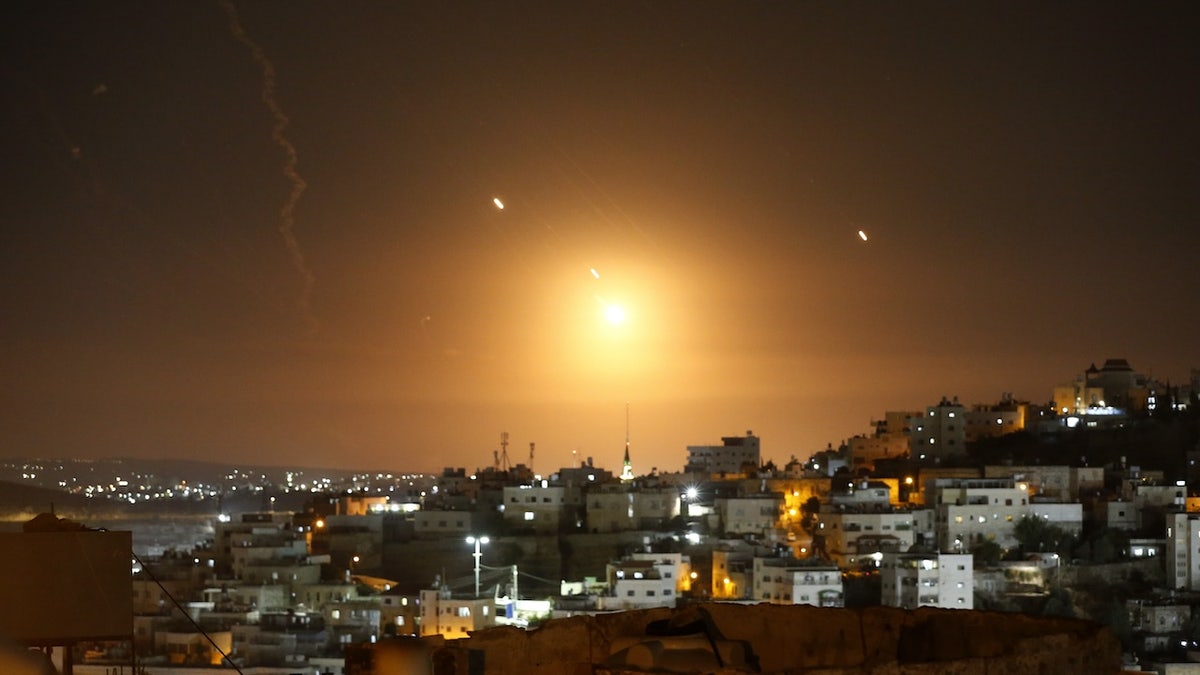
Military analysts are currently obsessed with the "measured response." They treat the recent U.S.-Israel strikes on Iranian infrastructure like a carefully calibrated chemistry experiment—as if adding $X$ amount of kinetic energy will result in exactly $Y$ amount of deterrence. This is a comforting lie sold to the public to prevent a run on the oil markets.
The consensus narrative suggests these strikes "restored a red line." In reality, they signaled a fundamental shift from deterrence to managed attrition. If you think the goal was to stop a war, you are looking at the wrong map. The goal was to test the integrated sensor-to-shooter loops in a live, high-threat environment. Iran wasn't the only target; the very idea of mid-century sovereignty was.
The Deterrence Trap
Standard geopolitical "experts" claim that by hitting specific military targets while avoiding oil refineries and nuclear sites, the coalition "threaded the needle."
This logic is flawed. Deterrence only works if the cost of the next action is perceived as unbearable. By telegraphing the limits of the strike—effectively telling Tehran "we won't hit your money or your nukes if you play nice"—the U.S. and Israel didn't project strength. They provided a roadmap for acceptable provocation.
I have watched defense contractors and policy wonks play this game for two decades. When you define the ceiling of your retaliation, you give your opponent the floor. Iran now knows exactly what it costs to launch a ballistic missile barrage. It costs a few radar sites and some manufacturing sheds. In the cold math of a revolutionary regime, that is a bargain.
The Technical Reality of Integrated Air Defense
While the media fawns over "stealth capabilities," the real story is the failure of the S-300 and the supposed "impenetrable" Russian-made shields. This wasn't just a strike; it was a total technical deconstruction.
We need to talk about the physics of the engagement. The coalition didn't just fly planes; they managed a massive, multi-domain data stream.
- Electronic Warfare (EW): The suppression of enemy air defenses (SEAD) wasn't about blowing up radars. It was about feeding them ghost data.
- The Kinetic Loop: The time from detection to impact has shrunk to near-zero.
When people ask "How effective was the strike?" they are asking about the craters. They should be asking about the packets. The strike proved that Soviet-era and even modernized Russian defense logic cannot handle high-volume, decentralized electronic interference. Iran’s "Integrated Air Defense System" (IADS) became a collection of expensive paperweights within the first twenty minutes.
Why Oil Markets are Wrong
The financial sector breathes a sigh of relief every time an explosion misses a pipeline. They think "no oil hit = no economic shock."
This is short-sighted. The price of oil is no longer just about supply; it is about the cost of insurance and the viability of the Strait of Hormuz. By normalizing direct exchanges between Israel and Iran, we have entered an era of "Permanent Low-Level War."
The risk isn't a sudden spike to $200 a barrel. The risk is a decade of "instability tax." Every shipment, every contract, and every regional investment now carries the weight of a conflict that has no off-ramp. You aren't seeing a de-escalation; you are seeing the establishment of a new, violent baseline.
The Fallacy of the Proxy War
The most tired take in the news today is that "Iran is losing its proxies."
Hezbollah and Hamas are not chess pieces that you simply sweep off the board. They are organic political and social movements with deep roots. You can kill the leadership—and the coalition has been very good at that—but the ideology thrives on the vacuum left behind.
The strike on Iran was meant to signal to these proxies that their patron is vulnerable. It won't work. Proxies don't fight because Iran tells them to; they fight because their local grievances are funded by Iran. Cutting the check doesn't kill the grievance. It just makes the fighters more desperate and less predictable.
Stop Asking if it "Worked"
The question is fundamentally broken. If "working" means Iran stops its nuclear program or ceases its regional ambitions, then no, it failed miserably.
If "working" means the U.S. and Israel successfully mapped every active Iranian radar frequency and tested their long-range refueling logistics under fire, then it was a staggering success.
This was a data-gathering exercise masquerading as a diplomatic message.
The Brutal Truths We Ignore
- The Nuclear Threshold: Iran is now closer to a weapon than they were before the strikes. Why? Because the "surgical" nature of the attack proved that conventional strikes cannot reach the deep-hardened sites. It validated Tehran's strategy of going underground.
- U.S. Overreach: Every time the U.S. participates in these "surgical" operations, it depletes its own stocks of precision-guided munitions. In a theater like the Pacific, this would be a death sentence. We are trading our high-end inventory for short-term headlines.
- The Pivot is Dead: You cannot pivot to Asia while you are babysitting the Levant. The strike didn't end a chapter; it started a sequel that the U.S. military cannot afford to film.
The Intelligence Failure of "De-escalation"
The Biden administration and its allies are obsessed with "de-escalation." It is a buzzword used by people who are afraid of the consequences of their own policy.
In the Middle East, "de-escalation" is often interpreted as "exhaustion." The parties stop shooting not because they have reached an agreement, but because they need to reload. By forcing a "measured" response, the West ensures that the conflict will be dragged out over years rather than settled in weeks.
We are subsidizing a slow-motion catastrophe.
The Engineering of the Next Conflict
Look at the hardware used. This wasn't a 1991 Desert Storm carpet bombing. This was a high-resolution, low-signature operation.
The math of the engagement looks something like this:
$$E = mc^2$$ is irrelevant here; the formula that matters is the probability of intercept $P_i$.
If $P_i < 0.1$, the defense is non-existent. The coalition proved that against modern Western tech, Iran’s $P_i$ is effectively zero. That realization doesn't lead to peace. It leads to a desperate arms race for asymmetric counters: drones, cyberattacks, and "dirty" maritime tactics.
The Actionable Reality
If you are an investor, a policy analyst, or just a citizen trying to make sense of the chaos, stop listening to the "surgical strike" rhetoric.
- Expect more, not less: This was a calibration, not a conclusion.
- Ignore the "Radical" label: Iran’s response won't be radical; it will be calculated and cynical.
- Watch the Red Sea: If the coalition hits the mainland, the proxies hit the shipping lanes. That is the only leverage they have left.
The status quo didn't change. It just got more expensive. The "explained" version of this story tells you the war was avoided. The insider version tells you the war just upgraded its software.
The era of the "surgical strike" is over. We are now in the age of the "forever tremor"—a constant, vibrating state of high-intensity conflict that never quite boils over into a world war, but never allows for a moment of peace.
Stop waiting for the "all clear" signal. It isn't coming.